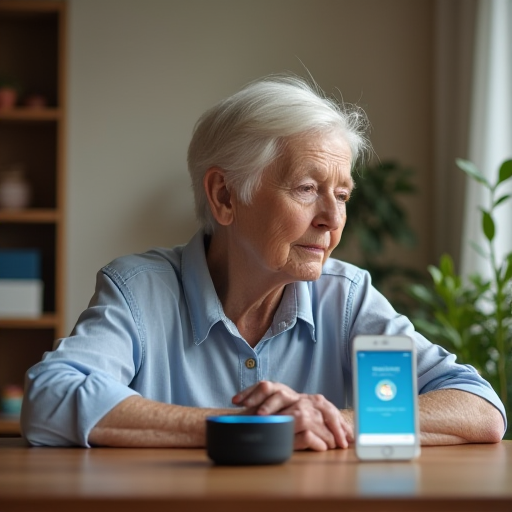
Technology That Can Help Older Adults Remain Independent
For many older adults, remaining at home is about more than comfort.
Moreover, it means preserving familiar routines, staying connected to neighbors, and maintaining a sense of control over daily life.
Technology cannot replace family members, caregivers or medical professionals.
However, voice assistants for seniors offer an additional layer of support and help with daily tasks.
However, the most useful technology is not always the most advanced. Additionally, voice assistants for seniors, fall-detection devices, AI companion technology, aging in place offer practical value. The right choice depends on the individual’s health, mobility, comfort with technology and available support.
Voice assistants for everyday tasks
Smart speakers such as Amazon Echo and Google Nest can perform basic tasks through spoken commands. An older adult might use one to set a medication reminder, make a shopping list, check the weather or control compatible lights and thermostats.
Voice control can be especially helpful for someone who has difficulty typing. It also assists those who have trouble reading a small screen or moving around the house. Once configured, compatible devices may lock doors, adjust blinds, or turn lights on before someone enters a dark room. This approach aligns with voice assistants for seniors, fall-detection devices, AI companion technology, aging in place.
These systems have limitations. They may misunderstand speech, require a reliable internet connection and collect information about how they are used. Medication reminders can help someone follow an existing routine, but a general-purpose voice assistant should not be trusted to determine dosages, identify drug interactions or replace advice from a pharmacist.
Sensors and emergency-alert devices
Falls are a serious concern for older adults. The Centers for Disease Control and Prevention reports that approximately one in four Americans age 65 and older falls each year.
Wearable emergency buttons and certain watches can contact a family member or monitoring service after a fall. Some devices attempt to detect falls automatically, while in-home sensors can monitor motion or identify changes in normal activity.
These features can help someone summon assistance, but no detection system is perfect. A device may miss a fall or generate a false alarm. Families should confirm exactly what a product detects, who receives an alert and whether professional monitoring requires a subscription.
Technology is only one part of fall prevention. Good lighting, secured carpets, nonslip bathroom surfaces, handrails and a professional assessment of medications and mobility remain important.
Digital companions and social connection
AI companion devices are being tested to reduce loneliness and promote healthy routines. Furthermore, ElliQ demonstrates voice assistants for seniors, fall-detection devices, AI companion technology, aging in place. It is distributed to eligible older adults through the New York State Office for the Aging.
ElliQ can initiate conversations, suggest activities and provide reminders. New York officials have reported high engagement and reduced loneliness among participants. Those results are encouraging, although they come from the program and should not be treated as proof that every user will have the same experience.
A digital companion may be useful for someone who enjoys regular interaction with technology. It should supplement—not replace—relationships with family, friends, neighbors and community organizations.
What current research tells us
A 2026 systematic scoping review published in JMIR AI examined 28 studies involving generative AI and older-adult health management. Researchers found promising applications in cognitive support, mental health and chronic-condition management.
The authors also urged caution. Much of the evidence comes from short-term studies involving cognitively healthy, relatively low-risk participants. Long-term effectiveness remains uncertain, and researchers identified continuing problems involving privacy, bias, voice-recognition accuracy and interfaces that are not designed around older users.
The evidence therefore supports careful experimentation rather than sweeping claims that AI has already transformed elder care.
Choosing technology carefully
Before purchasing a device or service, older adults and their families should ask several practical questions:
- Does it solve a problem the person actually has?
- Can the person operate it comfortably?
- What happens if the internet or electricity fails?
- Who receives an emergency alert?
- Is professional monitoring included or sold separately?
- What information does the company collect?
- Can recordings or activity data be deleted?
- Who will provide setup help and continuing support?
Whenever possible, begin with one clearly useful function. A voice reminder or automatic hallway light is easier to learn and evaluate than an entire collection of connected devices.
Independence still depends on people
Technology works best when it supports a broader plan involving family, healthcare professionals and community services. An emergency device is more useful when someone is prepared to answer its alerts. A medication reminder is safer when the medication schedule has been confirmed by a clinician or pharmacist.
The goal is not to fill a home with devices. It is to select a few dependable tools that make everyday activities safer, simpler or less isolating while respecting the older adult’s preferences and privacy.
Sources
- JMIR AI -The Role of Multimodal Generative AI in Older Adults’ Health Management (May 2026) by Ting Liu Yiming Taclis Luo Patrick Cheong-Iao Pang et al. Systematic scoping review evaluating how multimodal GenAI tools support older adults’ self-care health monitoring and well-being across critical geriatric health domains.
- 2. RoboZaps – Humanoid Robots in Elderly Care (March 2026) by Radica Maneva Comprehensive guide covering top companion robots Paro Hyodol ElliQ GR-3 including real deployment numbers market figures and clinical study results.
- 3. Fairway Mortgage – How AI Can Detect Elder Fraud by Bill Gates (paraphrased) – Discussion of AI-powered practical tools for daily life alongside fraud detection capabilities demonstrating dual-use nature of AI in home care settings.